Frameless Torque Motor Stator Mounting Guide: Press Fit, Thermal Shrink, and Bonding
A deep dive into frameless motor stator integration. Compare adhesive bonding, thermal shrink fitting, and press fit methods for OEM robotics and industrial axes.
Integrating a frameless torque motor means the OEM's machine housing becomes the motor's frame. The most critical step in this integration is stator mounting.
How the stator is secured determines the thermal path (which dictates continuous torque capability) and the mechanical stability (which dictates air gap integrity and safety). A stator that is deformed during mounting can rub against the rotor, while a stator with poor housing contact will overheat at a fraction of its rated continuous torque.
For OEM robotics, medical gimbals, and industrial direct-drive axes, engineers must decide between adhesive bonding, thermal shrink fitting (interference fit), press fitting, or axial clamping.
Below is an engineering guide to selecting the right stator mounting strategy based on thermal, mechanical, and production requirements.
There is no single "best" method. The right choice depends on the motor's diameter-to-length ratio, the housing material, the thermal load, and the manufacturing volume.
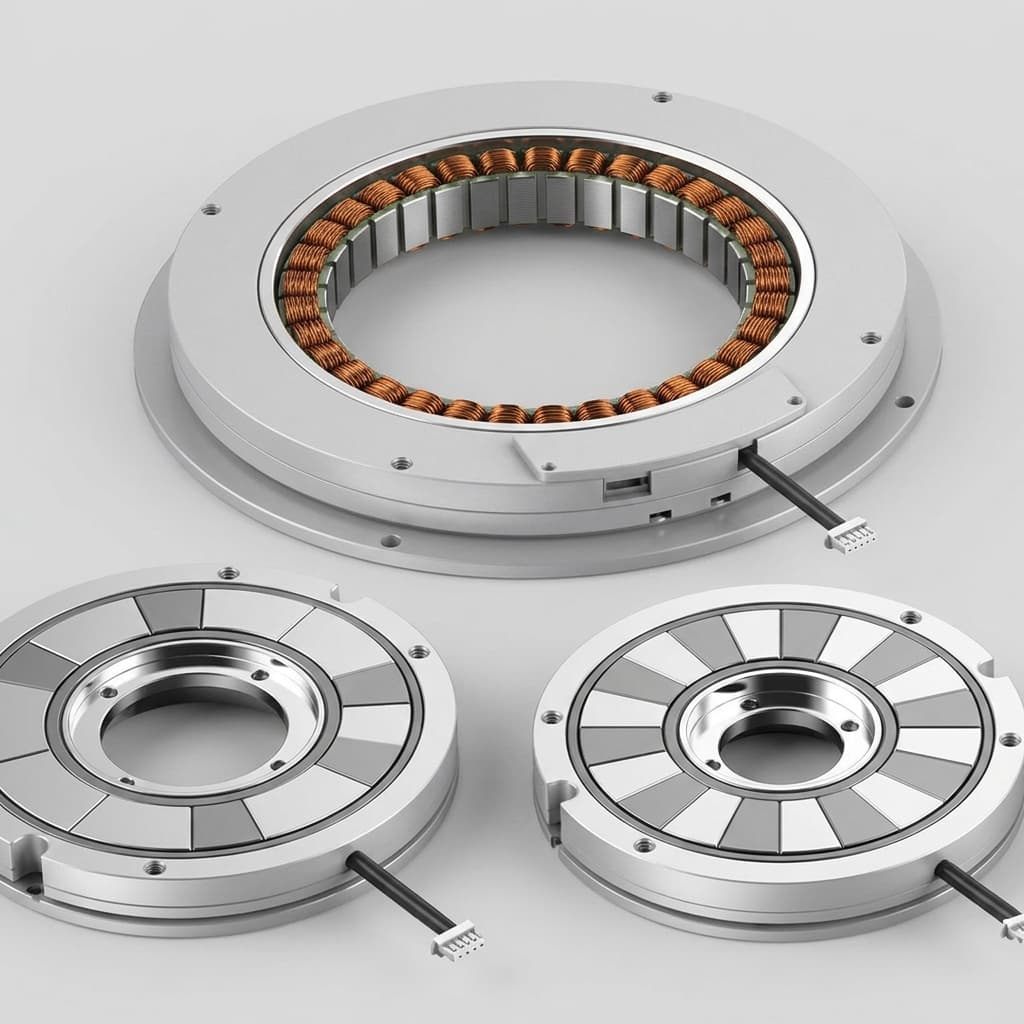
For collaborative robots, surgical tools, and optics, stators are often designed with very large inner diameters (ID) and thin laminations. Applying mechanical pressure to these thin rings can distort them into ovals.
Adhesive bonding uses a structural, thermally conductive epoxy to secure the stator. Because the housing is machined with a clearance fit, the stator drops in freely, and the epoxy fills the gap.
Modern integration increasingly relies on the thick bond line concept (e.g., 0.2mm to 0.5mm clearance).
Thin bond line: Requires extremely tight machining tolerances on the housing to keep the gap below 0.1mm for heat transfer.
Thick bond line: Relaxes housing tolerances, lowers machining costs, and acts as a buffer for mismatched Coefficient of Thermal Expansion (CTE) between a steel stator and an aluminum housing. By using highly thermally conductive epoxies, the thermal penalty is negligible.
Integration Checklist for Bonding:
Clean both surfaces with proper solvents to ensure adhesion.
Use a centering fixture (shim stock or precision arbor) to hold the stator perfectly concentric while the epoxy cures.
Verify the epoxy's glass transition temperature (Tg) exceeds the maximum winding temperature.
For heavy industrial applications where continuous torque and extreme rigidity are paramount, the thermal shrink fit provides the best metal-to-metal contact.
In this method, the housing is machined to an interference fit (slightly smaller than the stator OD). The aluminum or steel housing is heated (typically to 100°C - 150°C) until it expands enough for the room-temperature stator to drop in. As the housing cools, it shrinks and grips the stator with immense force.
Integration Checklist for Shrink Fitting:
Calculate the interference based on the operating temperature range. A cold housing can lose grip if it expands faster than the stator at high temperatures.
Ensure the stator is not forced or hammered in. It must drop in freely while the housing is hot.
Warning: Over-squeezing the stator can compress the laminations inwards, reducing the air gap and altering the magnetic flux, leading to unwanted torque ripple.
Press fitting uses a hydraulic press to force the stator into an interference-fit housing at room temperature.
While common for small catalog servo motors, it is highly discouraged for large frameless torque motors.
The axial force can shear the stator laminations.
It often causes "galling" (metal scraping), which traps debris and ruins concentricity.
It introduces asymmetrical stresses that destroy the precise air gap required for smooth low-speed control.
If a press fit must be used on a small-diameter frameless motor, ensure a generous lead-in chamfer on the housing and use appropriate assembly lubricants that will not degrade the winding insulation.
Some frameless stators can be ordered with an integrated flange or aluminum sleeve. This allows the stator to be axially clamped using bolts or a retaining ring.
While this makes the motor easy to remove and replace, it usually suffers from a poor thermal path. Heat must travel axially to the flange rather than radially through the entire OD. This method is best reserved for prototyping, low-duty-cycle indexing, or applications where torque density is not pushed to the limit.
OEM buyers often look at a frameless motor's datasheet and assume the "Continuous Torque" value is guaranteed. It is not.
Continuous torque is entirely dependent on the stator mounting method. A supplier's rated continuous torque is usually tested with the stator mounted in an ideal liquid-cooled or massive aluminum heat sink.
If you choose a poor thermal epoxy, or if your shrink fit loses contact at high temperatures, the thermal resistance increases. The windings will overheat much faster, forcing you to derate the motor's continuous torque by 20% to 50%.
When requesting a quote, always ask:
"What mounting method, housing material, and ambient temperature were used to determine your continuous torque rating?"
Before freezing your joint design or ordering expensive samples, review the mounting interface with your motor supplier. Share your housing material, available machining tolerances, and expected temperature range.
If you are evaluating frameless motors for a new direct-drive axis, review our Frameless Torque Motor Selection Guide or contact our engineering team to discuss customized mounting tolerances.
Which stator mounting method gives the best continuous torque?
Thermal shrink fitting typically provides the best metal-to-metal contact, leading to the lowest thermal resistance to the housing. However, highly conductive thin-bond-line epoxies can achieve very similar thermal performance without the high mechanical stress of an interference fit.
Can I use a press fit for a large diameter frameless torque motor?
Press fitting is generally not recommended for large-diameter, thin-walled stators. The high axial force required can easily deform the stator stack, leading to an uneven air gap, increased torque ripple, or even rubbing between the stator and the rotor.
What is the difference between a thick bond line and a thin bond line in adhesive mounting?
A thin bond line uses minimal epoxy to maximize thermal transfer but requires tight machining tolerances on the housing. A thick bond line intentionally leaves a larger gap (e.g., 0.5mm to 1mm) filled with structural, thermally conductive epoxy, which greatly relaxes housing tolerances and absorbs differences in thermal expansion.
How does stator mounting affect the air gap?
An improper interference fit can compress the stator inwards, reducing the already small air gap (often < 1mm). This can cause rotor rubbing or create an asymmetric magnetic field that drastically increases cogging torque and torque ripple.
Author
Jimmy Su
Frameless torque motor sourcing and application engineering. 10+ years in industrial motion control supply chain between China and global OEM markets.