48V Frameless Torque Motors for Mobile Robotics: A Buyer's Selection Guide
How to specify 48V frameless torque motors for AMRs, exoskeletons, and battery robots while balancing drive current, voltage sag, wiring, and thermal limits.
With the explosive growth of Autonomous Mobile Robots (AMRs), exoskeletons, and battery-powered portable equipment, the 48V DC bus has become the standard for mobile robotics. However, specifying a frameless torque motor for a 48V system requires a completely different approach than sizing one for a traditional 300V or 600V industrial machine.
The core challenge is simple: Power equals Voltage times Current. When you restrict the voltage to 48V (often for safety and battery modularity), the only way to achieve high mechanical power is by pushing massive amounts of current.
For buyers and engineering teams, this means your motor selection is constrained not just by mechanical space, but by the thermal limits of the wiring, the current ceiling of the servo drive, and the discharge capability of the battery pack.
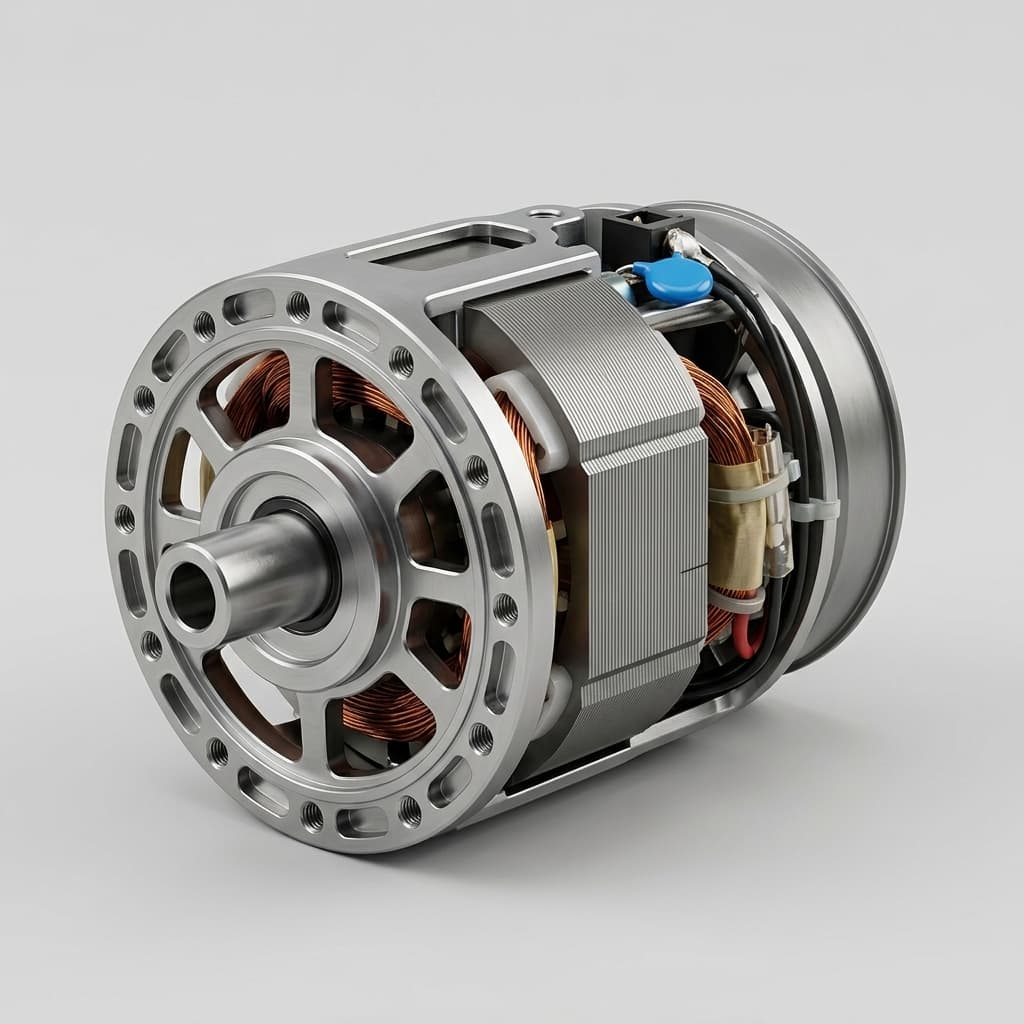
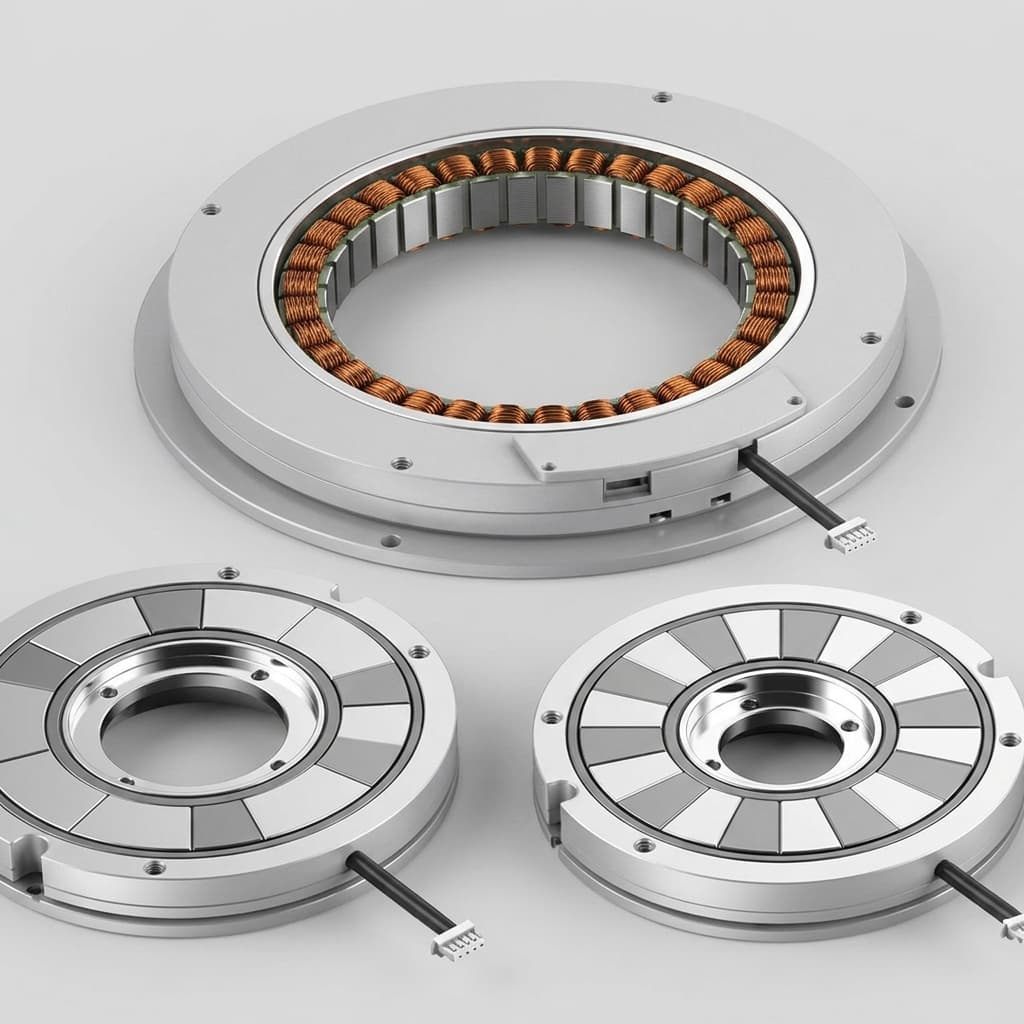
Here is a guide to selecting and evaluating 48V frameless torque motors for mobile robotics. If your team is still deciding whether a rotor-and-stator kit is the right actuator architecture, start with the broader frameless torque motor selection guide first.
Published and reviewed on July 21, 2026, this guide is written for global OEM engineering and procurement teams selecting low-voltage frameless torque motors for AMRs, AGVs, exoskeletons, cobot joints, and compact battery-powered actuator modules. It assumes a BLDC/PMSM servo system, a nominal 48V DC battery bus, field-oriented or sinusoidal control, and a supplier RFQ where the motor winding can still be adjusted.
Use this guide for first-pass motor, drive, battery, wiring, and thermal trade-off decisions. Do not use it as a replacement for final safety certification, EMC testing, wire ampacity review, battery protection design, or local compliance review. For speed sizing, use the lowest loaded battery voltage after voltage sag and drive voltage drop, not the nominal 48V value.
In traditional industrial machines running on a 300V or 600V bus, voltage headroom is rarely a problem. The primary limitations are mechanical size and high-voltage insulation.
At 48V, you run out of voltage very quickly. As the motor spins, it generates a back electromotive force (Back EMF) that opposes the supply voltage. If the Back EMF reaches 48V, the motor cannot spin any faster. To push the top speed higher, engineers select a winding with a lower voltage constant ($K_e$), which inherently means a lower torque constant ($K_t$). But a lower $K_t$ means the motor demands significantly more current to produce the same torque.
To understand how these limitations play out in a real design, let’s look at a hypothetical sizing exercise for an Autonomous Guided Vehicle (AGV) traction drive.
The engineering team needs the AGV to reach a top speed of 2.5 m/s, which requires the motor to spin at 400 RPM at the wheel. The required continuous torque for pushing a heavy payload is 15 Nm, and the peak torque required for climbing a ramp is 45 Nm. The battery is a 48V Li-ion pack, and the servo drive has a peak current limit of 100 Amps.
Step 1: Check the Voltage Sag. The team discovers that while the battery is fully charged at 54V, under the 100 Amp load required to climb the ramp, the battery voltage sags to 42V.
Step 2: Calculate Required $K_e$. To hit 400 RPM at 42V (minus a 2V drop across the drive), the motor only has 40V available. The motor's Back EMF constant ($K_e$) must be low enough so that at 400 RPM, it generates less than 40V. This forces the selection of a high-speed, low-$K_e$ winding.
Step 3: The Current Penalty. Because $K_e$ and $K_t$ are proportional, lowering the $K_e$ to hit the speed target also lowers the torque constant ($K_t$). The team finds that the required winding has a $K_t$ of 0.4 Nm/A.
Step 4: Will the drive survive? To hit the 45 Nm peak torque target, the motor will demand $45 / 0.4 = 112.5$ Amps. But the servo drive is limited to 100 Amps! The AGV will never climb the ramp.
The Solution: The team has three choices. They can upgrade to a 150A servo drive (adding cost and size). They can reduce the top speed requirement, allowing them to use a winding with a higher $K_t$. Or, they can select a physically larger frameless motor, which inherently produces more torque per amp (higher intrinsic $K_t$ for the same speed rating). They eventually choose a slightly larger motor OD, which solves the current limit problem without sacrificing speed.
Before issuing an RFQ, cross-check the torque-speed assumptions against these common frameless torque motor sizing mistakes, especially if the peak torque number comes from a short acceleration or ramp-climb event.
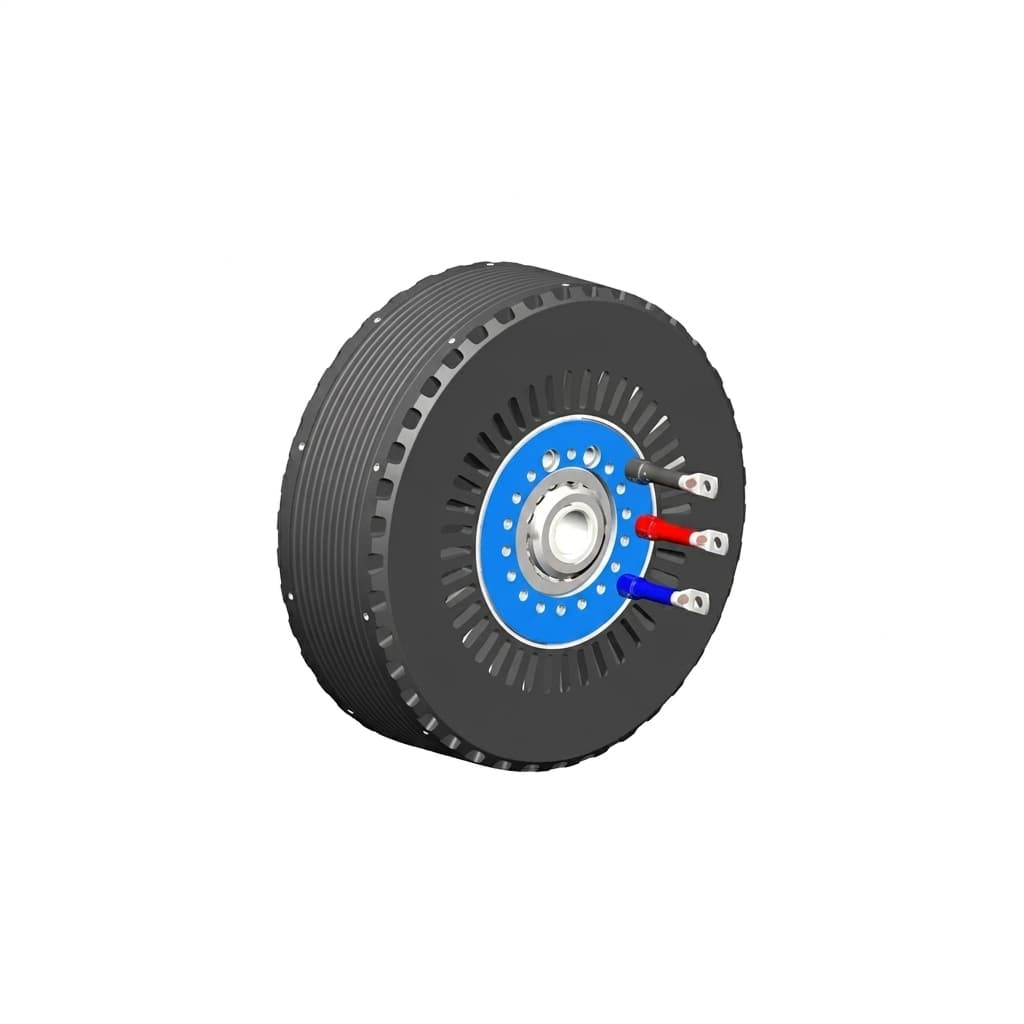
Because 48V motors rely on high current to generate torque, the lead wires must be much thicker than those on high-voltage motors of the same power rating. A 100-amp peak current could easily require 6 AWG or 8 AWG lead wires to prevent the cables from melting.
If you are designing a compact cobot joint, a slim exoskeleton actuator, or an integrated AGV wheel, thick lead wires are a nightmare. They have a large minimum bend radius, they are stiff, and they can easily interfere with hollow-shaft encoders or bearing retainers. Furthermore, thick wires act as heat conduits, transferring motor heat directly into your drive electronics.
Purchasing Tip: Always ask the motor supplier about the required wire gauge (AWG) early in the RFQ process. Some suppliers can offer custom flat-flex cables (FFC) or custom copper busbars to help route high currents through incredibly tight spaces. If your joint rotates more than 360 degrees, you will also need to spec a slip ring capable of handling massive phase currents, which is often larger than the motor itself.
While the motor stator and rotor do not inherently care what voltage they run at, the surrounding sensors do. When selecting feedback devices for a 48V mobile application, pay attention to the interference generated by high phase currents.
High current switching inside a tight metallic joint housing generates severe Electromagnetic Interference (EMI). If you run unshielded encoder cables parallel to your 48V motor phase wires, the electrical noise can easily corrupt the position signal, leading to erratic commutation and servo drive faults.
Resolver: Highly robust against EMI, making it ideal for high-current applications, but resolvers are often too bulky for thin 48V joints.
Optical Encoders: Provide exceptional resolution, but are susceptible to vibration and dust in mobile robotics. The cabling must be heavily shielded from the motor phases.
Magnetic Encoders: The most popular choice for compact 48V joints. However, the magnetic encoder chip must be carefully shielded from the stray magnetic fields generated by the motor's high-current stator windings, which can warp the position reading.
Q: Can I use a standard 240V motor winding at 48V?A: Technically yes, but performance will be severely crippled. A 240V winding has a high Back EMF constant. At 48V, the motor will hit its voltage limit at a very low speed. It will also have high resistance, limiting the current you can push through it. The motor will likely just stall out when put under load.
Q: Why not just use 24V instead of 48V?A: At 24V, you need exactly twice the current to achieve the same power as 48V. For high-torque applications like traction wheels or lifting joints, 24V currents quickly exceed the capabilities of standard servo drives and require unreasonably thick cables that cannot physically fit into the joint design.
Q: Are custom windings expensive for 48V?A: Custom windings are standard practice for OEM frameless motors. If you are buying in production volumes, adjusting the copper winding to perfectly match your 48V battery curve usually does not add significant cost, but it dramatically improves efficiency and battery runtime.
Q: How does ambient temperature affect a 48V motor?A: Because 48V motors draw massive currents, they are heavily dependent on $I^2R$ copper losses. As the motor heats up, the copper resistance increases, which means the motor draws even more current to produce the same torque. If the ambient temperature is high (e.g., a robot operating in a hot warehouse), the motor can quickly enter a thermal runaway condition if it is not properly heat-sinked to an aluminum chassis.
Q: Is cogging torque worse at 48V?A: Cogging torque is a mechanical and magnetic phenomenon (the interaction between the rotor magnets and stator teeth). It is independent of the winding voltage. However, because 48V systems often struggle with low-speed current control resolution at very high current scales, torque ripple might feel worse if the servo drive is not tuned perfectly.
Before contacting a supplier for a 48V frameless motor, make sure you have defined the following electrical boundaries. Sharing this with your supplier prevents quoting a motor your drive cannot spin.
Minimum Battery Voltage: What is the lowest voltage the battery will output before cut-off (e.g., 40V)? Do not use 48V for your speed sizing.
Maximum Drive Current: What is the continuous (RMS) and peak current limit of your 48V servo drive?
Required Top Speed at Min Voltage: Can the motor still hit the maximum required joint speed when the battery is almost empty?
Thermal Path: Will the motor be mounted in a heat-dissipating aluminum frame, or isolated in a plastic exoskeleton shell?
Cable Routing: Can your joint design accommodate the bending radius of high-current AWG wires, or do you need a custom busbar?
Duty Cycle Profile: Define the exact duration of peak torque (e.g., 20 seconds during acceleration vs. 2 milliseconds of impact).
EMI Shielding Plan: How will you protect the magnetic or optical encoder from the massive EMI generated by the 48V high-current phase wires?
Matching a frameless torque motor to a 48V battery pack and a high-current servo drive requires balancing $K_t$, $K_e$, resistance, and thermal paths.
Instead of guessing from a catalog, start with our frameless torque motors or explore custom OEM motor assemblies for tailored 48V windings. If your joint package is already constrained, contact our engineering team at [email protected] for a winding optimization review.
Why do battery-powered robots use 48V instead of higher voltages?
48V nominal battery systems are commonly chosen because many pack designs can remain below common SELV/PELV DC touch-voltage thresholds even when fully charged, while still delivering more practical power than 12V or 24V. Final safety limits depend on the applicable market standard, battery chemistry, BMS design, and enclosure.
What is the biggest mistake when selecting a 48V frameless motor?
Ignoring the drive current limit. To get high torque at low voltage, the motor needs a high current winding. If your servo drive cannot supply that peak current, you will never reach the quoted peak torque.
How does 48V affect frameless motor top speed?
Lower bus voltage means lower speed capability before Back EMF (Ke) equals the supply voltage. High-speed 48V applications require very low Kt windings, which increases the current required to generate torque.
Should I select a standard or custom winding for a 48V mobile robot?
For battery applications, custom windings are often justified. They allow the motor's torque constant (Kt) to be perfectly matched to the specific battery discharge curve and the amplifier's maximum continuous current.
Author
Jimmy Su
Frameless torque motor sourcing and application engineering. 10+ years in industrial motion control supply chain between China and global OEM markets.